01 — THE STARTING POINT
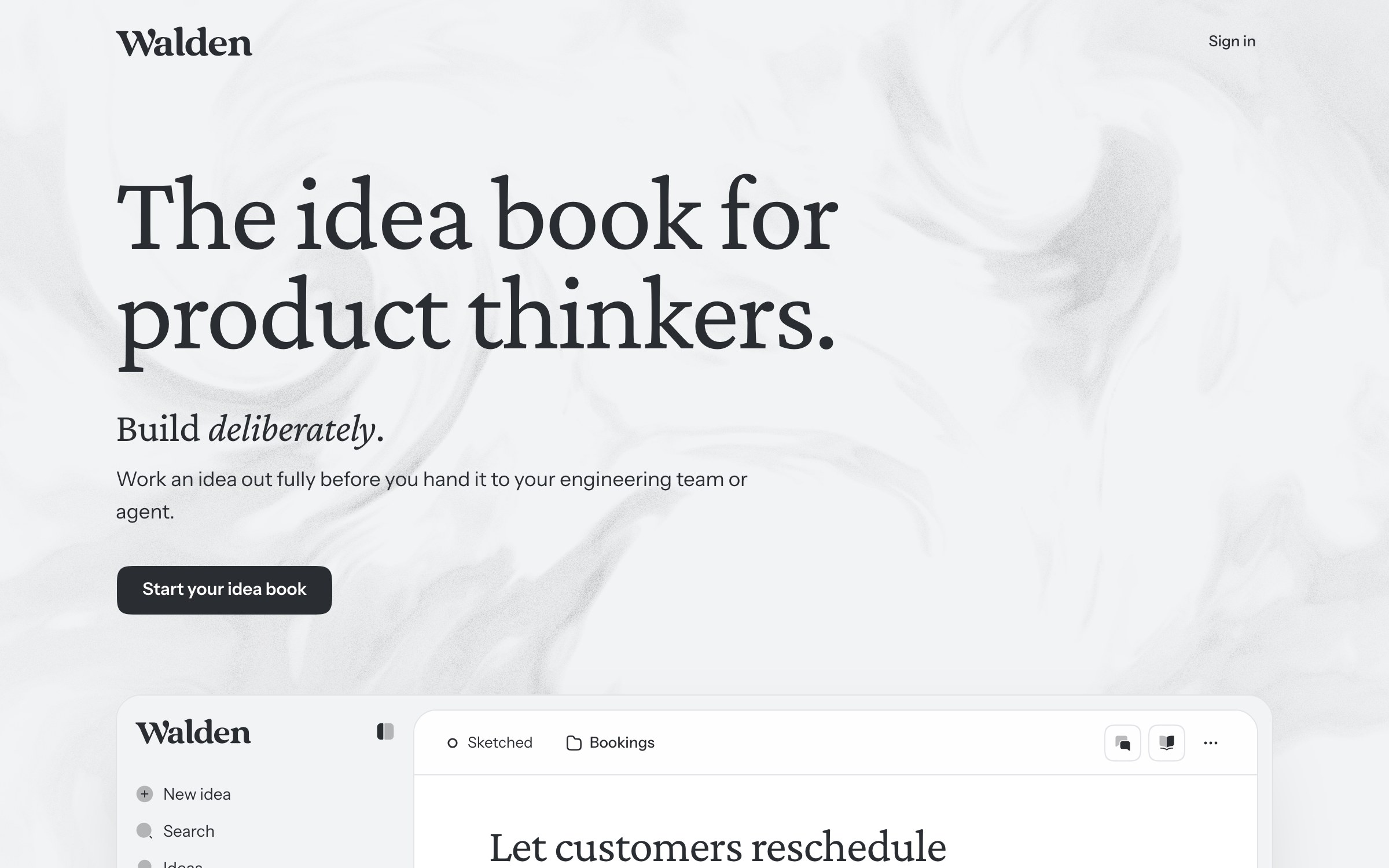
Building software has gotten fast. Engineering teams ship faster with AI tools, and a solo founder can run an agent as the whole product team, so the build hours are no longer the scarce resource, it's judgement.
Walden is a tool that helps you build better software and solve the right problems. You can build your idea, get a second opinion (with our built-in tools or while collaborating in real-time with your team). It helps you consider edge cases, it can have context of your codebase to better understand how a solution would fit, and lets you know what you might be leaving out.
02 — THE CALLS WE MADE
01
Shaping the idea
Walden is named after the pond Thoreau visited from 1845 to 1847. During his stay, he sounded the lake, because everyone said it was bottomless. It was 102 feet. The identity is inspired by that survey: graphite on paper, solid lines are decided, dashed lines are still open, a dot is a measurement taken. Crimson Pro, Instrument Sans, and Source Code Pro help to tell the story. Ultramarine is the only colour and reserved for contrast.

Build deliberately.
Walden Pond, sounded 1846 · 102 ft
Paper
#F2F3F4
The desk
Card
#FFFFFF
The sheet
Rule
#E2E4E7
One light rule
Graphite
#2A2E33
The only dark
Ink soft
#6C7379
Labels
Ultramarine
#2B3BFF
Walden’s own
Still open
dashed · hollow
Decided
solid · filled
Measured
a dot
- AaCrimson Pro thinksTitles and the person’s own words
- AaInstrument Sans operatesEvery label, control and row
- 102 ftSource Code Pro countsCaptions and figures, nothing else
02
AI as a tool for shaping the idea
The AI writing tools offer to draft different parts of the document, and the author can choose to keep or discard the draft. Walden's readers — a builder, a fair skeptic, or a custom reader the author creates — leave questions in the margin and never alter the text. These second readers help you find holes in your idea and can be accepted as an open unknown on the page.
Second reader
Pick one to have the pitch read
Approach
Add a Reschedule link to the reminder email. It opens a page with their current time and the open slots, and they pick a new one.
2 on this block
Unknowns2 open
- What if there are no open times before their appointment?Open
- Can someone reschedule less than a day before?Open
Not doing
- Cancelling from the link
- Moving someone else’s appointment
- Changing the service, only the time
03
Working out the details
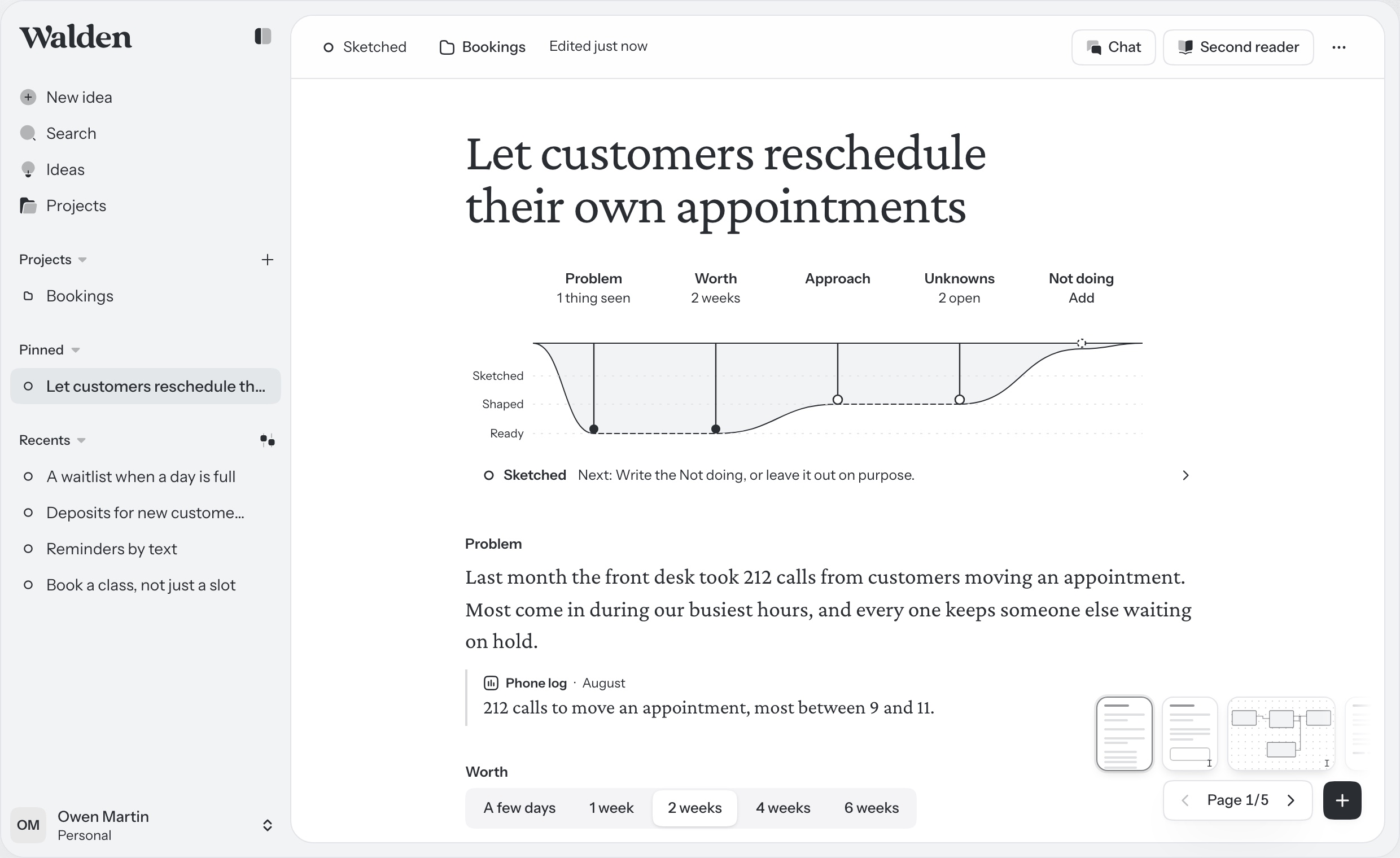
The depth strip drops a line on each part of the idea to help you visualize how well you've shaped your ideas before you start building. If the line is dashed, you've still got work to do and the readers can help you find the holes.
Let customers reschedule their own appointments
- ProblemDoes it say who has the problem, and what goes wrong for them?Does it rest on something seen, said or counted?Ready
- WorthIs a size set?Does it say why this much, and not more?Ready
- ApproachAre the main parts named, and how they fit together?Are the big decisions made, with anything else plainly left to the builder?Shaped
- UnknownsDoes it name questions whose answer would change the approach?Are those settled, with what was decided?Shaped
- Not doingDoes it leave something out on purpose?Does it refuse things someone would really ask for?Ready
Each answer comes from reading the page as last saved. Readiness stops nothing, and it stays with you: it isn’t exported.
04
Sketched fragments
Fragments are generated while you're building a flow and can optionally have context from your codebase. When you create a new flow, you define places, their actions, and connections. Walden helps you to visualize each screen by using your flow as a blueprint of what to draw, to help drive discussion around the idea.
Flow3 places
- ReschedulePick a time
- Keep my time
- Choose an open slot
- Confirm new timeConfirmed
- Add to calendar
- Change againPick a time
UI sketchPick a time
Pick a new time
With Dr. Sassoon, 45 minutes
Open this week
- 1Show their current time, so they know what they’re moving.
- 2Disabled until a slot is picked; the old time is held until then.
03 — WHAT SHIPPED
Walden is live at walden.so. An idea starts as a simple prompt and becomes a ready-to-build idea. Building our your idea, flows, sketches, canvases, and export are free without a card. Even the free plan comes with AI credits to test out these features.
As you build your idea, you can add flows and the UI sketches drawn from them, a canvas to ideate in and collaborate with your team, and a hand-off as Markdown, a PDF, or a package an engineering team or a coding agent can run with. If you connect your repository, the readers, chat, and sketches start from the product's real codebase so you can build from previous patterns and decisions as context.
04 — AFTER YOU'VE SHAPED YOUR IDEA
Walden can fit into your product development process and work with the tools your team already runs: Jira, Linear, Notion, GitHub, coding agents.
It's the studio's own product — designed, engineered, and operated by the same team that builds for clients — and the standard client work is held to: we build deliberately and work through each idea to ensure we're building the best possible solution.